
COLLABORATIONOS / OPEN GOVERNANCE FRAMEWORK
CollaborationOS
Inspectable governance for consequential human-AI collaboration.
CollaborationOS gives teams a disciplined, human-owned way to recover context, admit evidence, bind authority, govern execution, review outcomes independently, and preserve failure truth.
01 / SYSTEM ARCHITECTURE
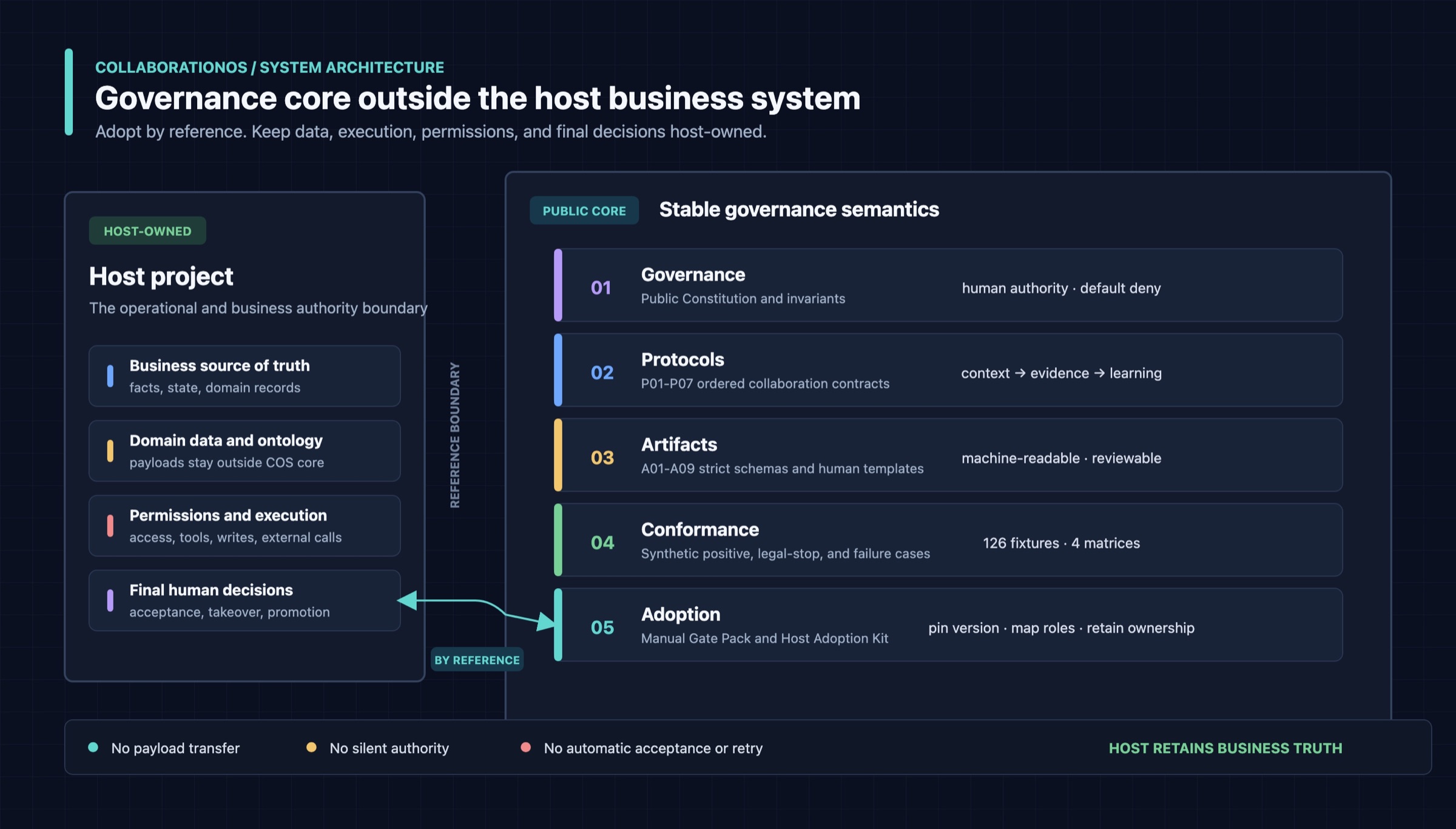
Governance outside the host business system.
COS is adopted by reference. The public core supplies governance semantics, protocols, artifact contracts, conformance examples, and adoption guidance. The host retains its business source of truth, domain data, permissions, execution systems, and final decisions.
02 / SEVEN-PROTOCOL GOVERNANCE LOOP
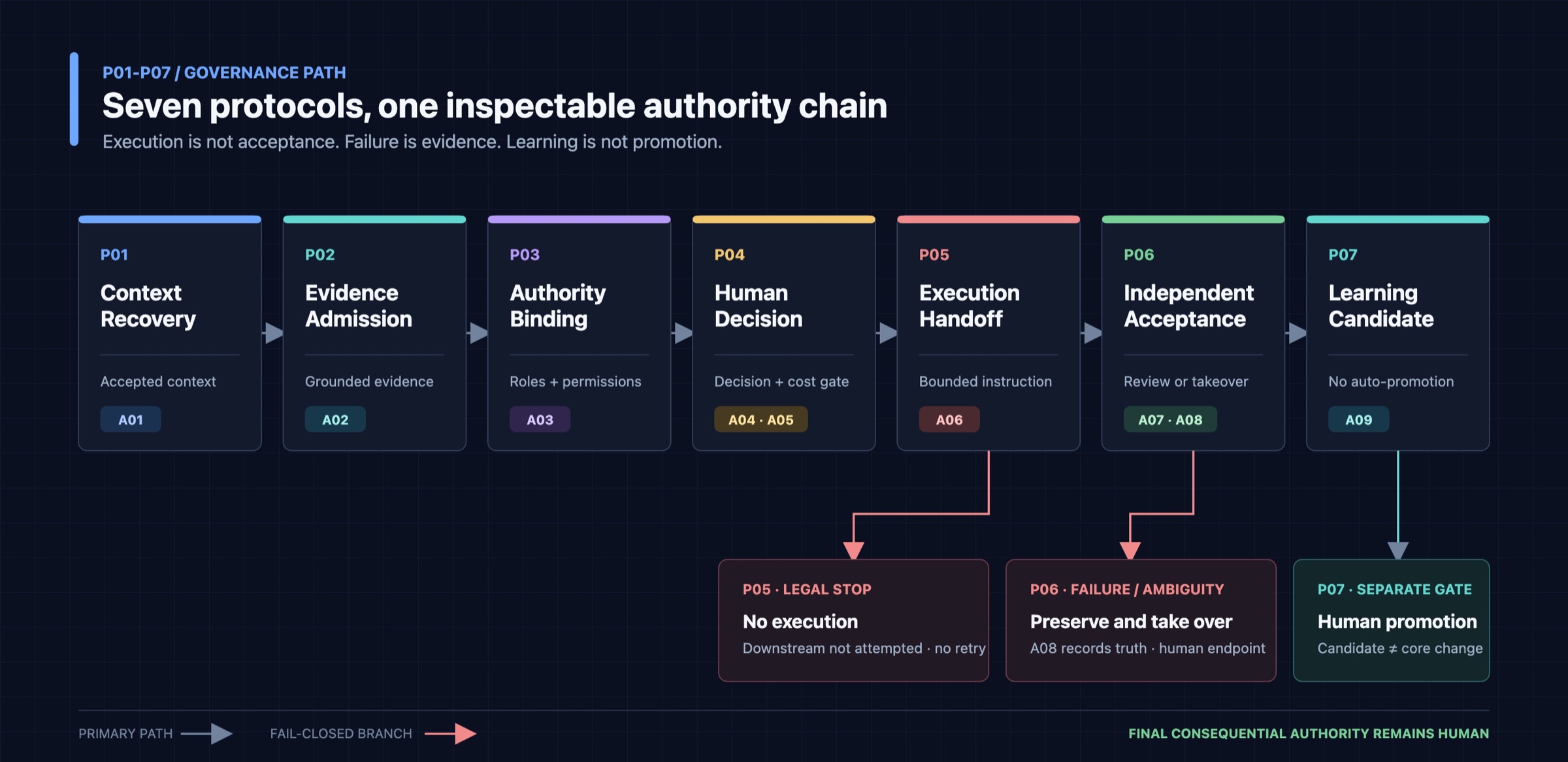
Seven protocols. One inspectable authority chain.
P01-P07 connect context recovery, evidence admission, authority binding, human decision, execution handoff, independent acceptance, and learning candidates. A01-A09 keep each transition machine-readable and reviewable without allowing later success to create authority retroactively.
03 / HOST ADOPTION PATH
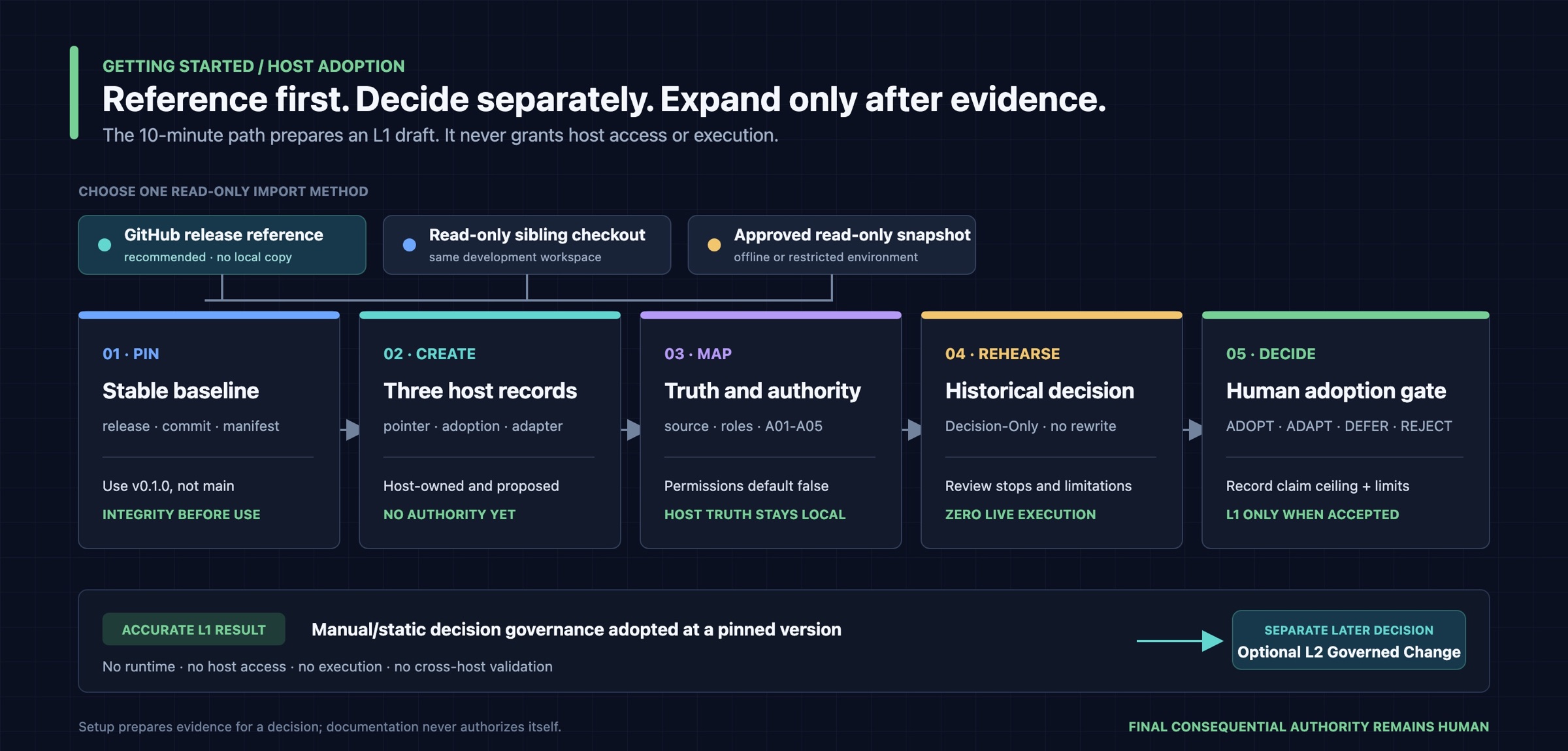
Reference first. Decide separately. Expand only after evidence.
A host pins the public baseline, imports it read-only, creates host-owned governance records, maps truth and authority, rehearses one historical decision, and routes adoption to an independent human owner. The 10-minute path prepares an L1 draft; it does not grant access or execution.
PUBLIC CAPABILITY BOUNDARY
A governance baseline, not an authority engine.
Public v0.1.0 is manual/static, Apache-2.0 licensed, and designed around human-owned consequential authority.
WHAT IT DOES
- Makes context, evidence, authority, decisions, and acceptance inspectable
- Provides 7 protocols, 9 strict schemas, templates, and synthetic conformance evidence
- Preserves legal stops, failure truth, manual takeover, and bounded learning candidates
- Supports reference-based host adoption while keeping business truth local
WHAT IT DOES NOT DO
- No agent runtime, automated policy engine, CLI, SDK, or SaaS authority
- No host access, production execution authority, or automatic approval
- No implicit retry, acceptance, promotion, or canonical write
- No completed cross-host validation, M6 claim, or production-readiness claim
FROM UNDERSTANDING TO ADOPTION
Read the framework. Pin the baseline. Start with one decision.
The README explains the public invariants and repository map. Getting Started provides the shortest bounded path to a host-local L1 adoption draft.
DISCUSSION OPEN
Start with the boundary that is hardest to define.
Designing a consequential workflow shared by people, AI, and domain experts? I am open to discussing its real constraints and accountability boundaries.